
Ely Camp Is Closed
The official NDOC Ely Conservation Camp page labels ECC “CLOSED.” That status controls how the facility name should be read. An old record showing an assignment to the camp is historical evidence. It does not establish current custody, a recent release, or the person's location today.
Do not call the camp an active jail or prison. Do not direct a present-day release question to it. NDOC remains the relevant custodian because ECC was part of the state correctional system. The offender ID is the most reliable bridge from the old facility reference to a later prison placement, parole record, release entry, or inactive discharge status.
Ely Camp Closed Status
The NDOC facility record for Ely Conservation Camp is the official source for the closed designation that governs every current lookup.
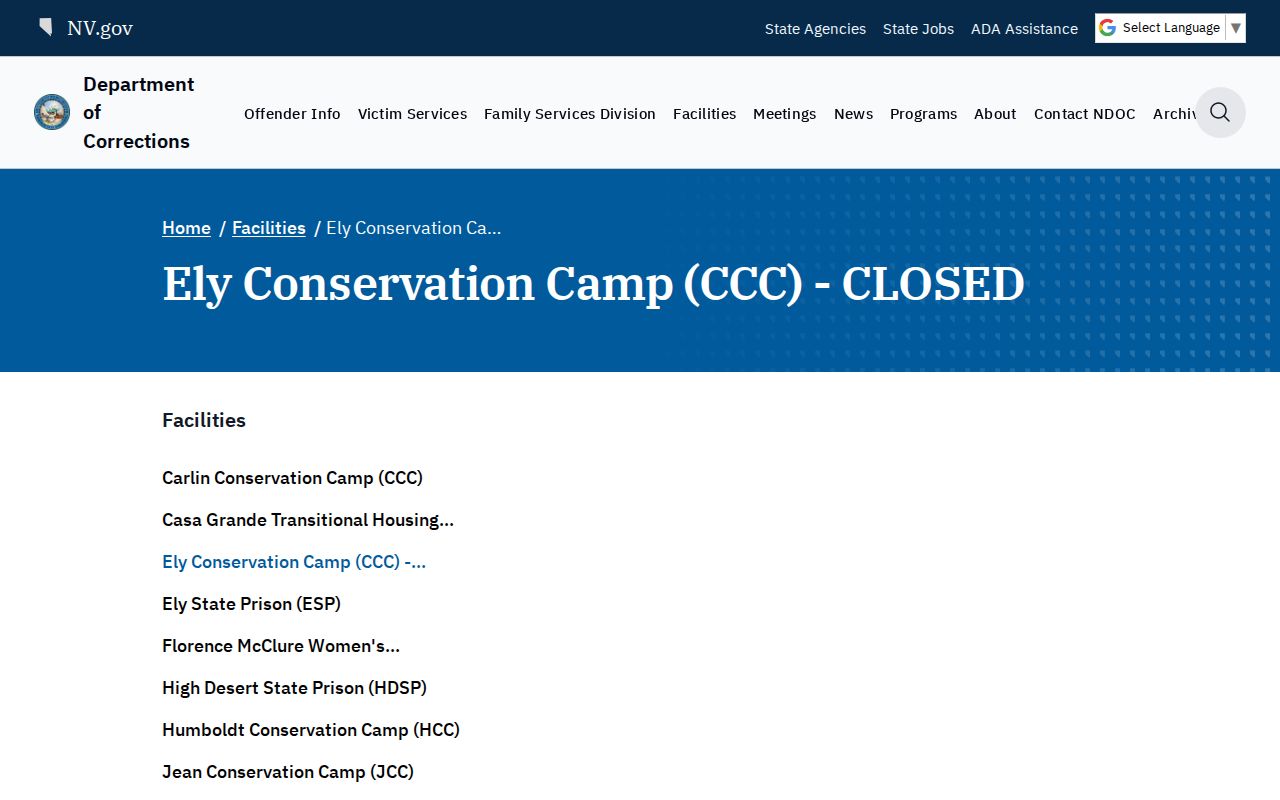
The image documents the facility's historical status, while the statewide offender system supplies the later custody, parole, release, or discharge trail for a known person.
Ely Camp Release Trail
A person's path after ECC may include another NDOC institution, parole, residential confinement, mandatory release, discharge, or a later return to custody. The camp name alone does not identify which occurred. A transfer is especially easy to mistake for release. Moving from the camp to Ely State Prison or another state institution would preserve NDOC custody.
The correct goal is to locate the next recorded state event. Start with the NDOC Offender ID if the historical document supplies it. Then inspect the current agency location or inactive status, release data, parole data, and later booking information. A past release can be followed by a new commitment, so no single old line should be read in isolation.
| Later record | Meaning | Conclusion |
|---|---|---|
| Active NDOC institution | The person is in state institutional custody. | ECC was only an earlier assignment. |
| PAROLE | The person left prison and remains supervised. | Verify through Nevada Parole and Probation. |
| INACTIVE-DSCHREL | NDOC shows an inactive released or discharged value. | Compare it with the release date and description. |
| Later booking | A new commitment followed an earlier event. | The old release is not current status. |
Search Ely Camp Records
Open the official NDOC offender search. The form accepts an Offender ID or a first and last name. The numeric ID is best for a historical ECC record because it follows the person when a facility name changes. Name searches can use percent-sign wildcards, but similar names and aliases require care.
- Copy the NDOC Offender ID from the old ECC record when it is available.
- Search that ID and read the agency location or status on the matching person record.
- Check release, parole, booking, and alias information for the sequence after the camp assignment.
- Request an official NDOC record if the public raw-data portal does not establish the event with enough certainty.
A name-only result should be matched with middle name, approximate age, and other non-sensitive facts. The search is capped at the first 20 matches. A broad surname that does not show the target is not a no-record finding. Narrow the query or locate the Offender ID from the court or older correctional file.
NDOC warns that the portal contains raw data, is not guaranteed error-free, and is not an official record for an agency or other entity. Family Services takes inmate questions at 775-977-5707. That warning matters more with an old camp reference because the user is already connecting records created at different times.
Ely Camp Release Fields
The NDOC download structure can help reconcile those dates. Its release file contains the offender ID, offender booking ID, release date, and release description. The demographic data includes the current agency or status-like value. Separate booking, parole, and alias files can show another commitment, a hearing event, or a name variant.
A parole hearing is not a physical release. A release entry is stronger evidence of a custody exit, but it should still be compared with the current status and later bookings. NDOC's observed descriptions may include unusual spelling. Preserve the official text and ask the agency to interpret an unclear code rather than correcting or expanding it from assumption.
- Historical assignment
- A past facility placement that does not state the person's status today.
- Transfer
- A move between custodians or institutions without community release.
- Parole
- Release from prison into supervised community status.
- Discharge
- The end status recorded by the correctional agency.
Sentence data also includes abbreviated labels that NDOC does not fully define on the public portal. Do not infer a projected release from a familiar-looking abbreviation. Offender Management should explain the field and sentence context when the date matters.
Request Ely Camp History
NDOC, not White Pine County, is the proper records custodian for an ECC assignment and its later state correctional events. A focused request should identify the person, Offender ID, approximate camp dates, and the exact records sought. Ask for facility-assignment history, the next institution or status, the release or discharge record, and the sentence computation summary if it is disclosable.
Initial offender-record inquiries go to omdrecords@doc.nv.gov or to Offender Management Division, Nevada Department of Corrections, P.O. Box 7011, Carson City, NV 89702. General public-record questions go to publicrecords@doc.nv.gov or 775-977-5649. Those channels replace any attempt to seek current service from the closed camp.
NDOC states inspection hours of Monday through Friday, 8:00 a.m. to 5:00 p.m. Its posted terms include black-and-white copies at $0.15 per page, electronic media at cost, a $5 amount for specified audio or video on CD or DVD, possible extraordinary-use fees, prepayment, and shipping. An estimate is supplied when expected charges exceed $25. Prepared materials may be held for thirty days.
The thirty-day period governs prepared request material, not the retention of the underlying offender record. No universal retention term for every ECC release or assignment record was established in the research. Ask NDOC to identify the applicable record series and retention schedule if that issue is important.
Note: A narrow request tied to the offender ID and known dates is less likely to confuse an old camp assignment.
Three Ely Release Systems
Ely has three correctional names that must remain separate. White Pine County Jail is active and operated by the Sheriff. Ely State Prison is active and operated by NDOC. Ely Conservation Camp is an NDOC historical facility marked closed. A search for “Ely inmate release” can surface any of the three.
| Facility | Present role | Release-record route |
|---|---|---|
| White Pine County Jail | Active local detention | Sheriff status, County Clerk record, and county court disposition. |
| Ely State Prison | Active state institution | NDOC offender and release data, then P&P for parole. |
| Ely Conservation Camp | Closed historical camp | NDOC assignment history and the person's later status. |
The difference affects every conclusion. A White Pine County Jail transfer to NDOC is not community release. A person paroled from Ely State Prison remains supervised. An ECC entry cannot be current custody. Match the operator and the record date before choosing the next agency.
The Ely State Prison release page addresses the active prison route. County jail events instead belong to the Sheriff, Clerk, and courts. Keeping these systems apart avoids asking one agency to certify a record it did not create.
Ely Camp Parole Records
If the later NDOC status is PAROLE, the person left prison but remains under legal supervision. The Nevada Board of Parole Commissioners handles parole release decisions. The Nevada Department of Public Safety, Division of Parole and Probation, supervises people in the community. A hearing record or Board action does not prove the date of physical release by itself.
Compare the Board action with the NDOC release entry. Monthly action reports warn that eligibility dates can change and that hearings near a month's end may appear later. Once release to parole is established, use the Division of Parole and Probation for the current supervision route.
Full discharge is different. It indicates the correctional status ended as recorded by NDOC. An inactive discharge or release value should be paired with the actual release date and description. If those sources conflict, request the official record rather than selecting the result that seems most likely.
Verify Ely Camp Discharge
Historical correctional research often joins a facility assignment, sentence file, release entry, and current status. Each record has a narrow role. The ECC page proves the camp is closed. It does not prove what happened to a particular person. The NDOC search identifies the offender. Release and booking records show the sequence. An official request resolves uncertainty.
Projected dates should be treated as estimates, not commitments. Credits, detainers, court action, parole decisions, and recalculation can change them. A detainer is a legal basis or request for another agency to take custody. Even if an NDOC sentence ends, another hold may prevent community release.
No operating federal prison or ICE detention center was found in White Pine County's reviewed official sources. Federal or immigration custody may still follow a state event. When a record names another agency, continue with that custodian. A missing result in one locator is not proof that every form of custody ended.
Use the smallest set of facts needed to verify the event. Record the source date, exact status text, and whether the evidence describes a facility, hearing, transfer, release, or discharge. That disciplined approach gives the closed Ely Conservation Camp its proper role: a historical waypoint within the person's NDOC record, never a current release office.